Cart
0
THE SCIENCE OF LIGHT
Photobiomodulation, put simply.
Light at specific wavelengths does measurable things to skin. Not through heat or abrasion, but by signalling the cellular machinery beneath the surface. Decades of peer-reviewed research back what the right light, at the right dose, can do. OmniGlow is built on that research.
HOW LIGHT REACHES SKIN
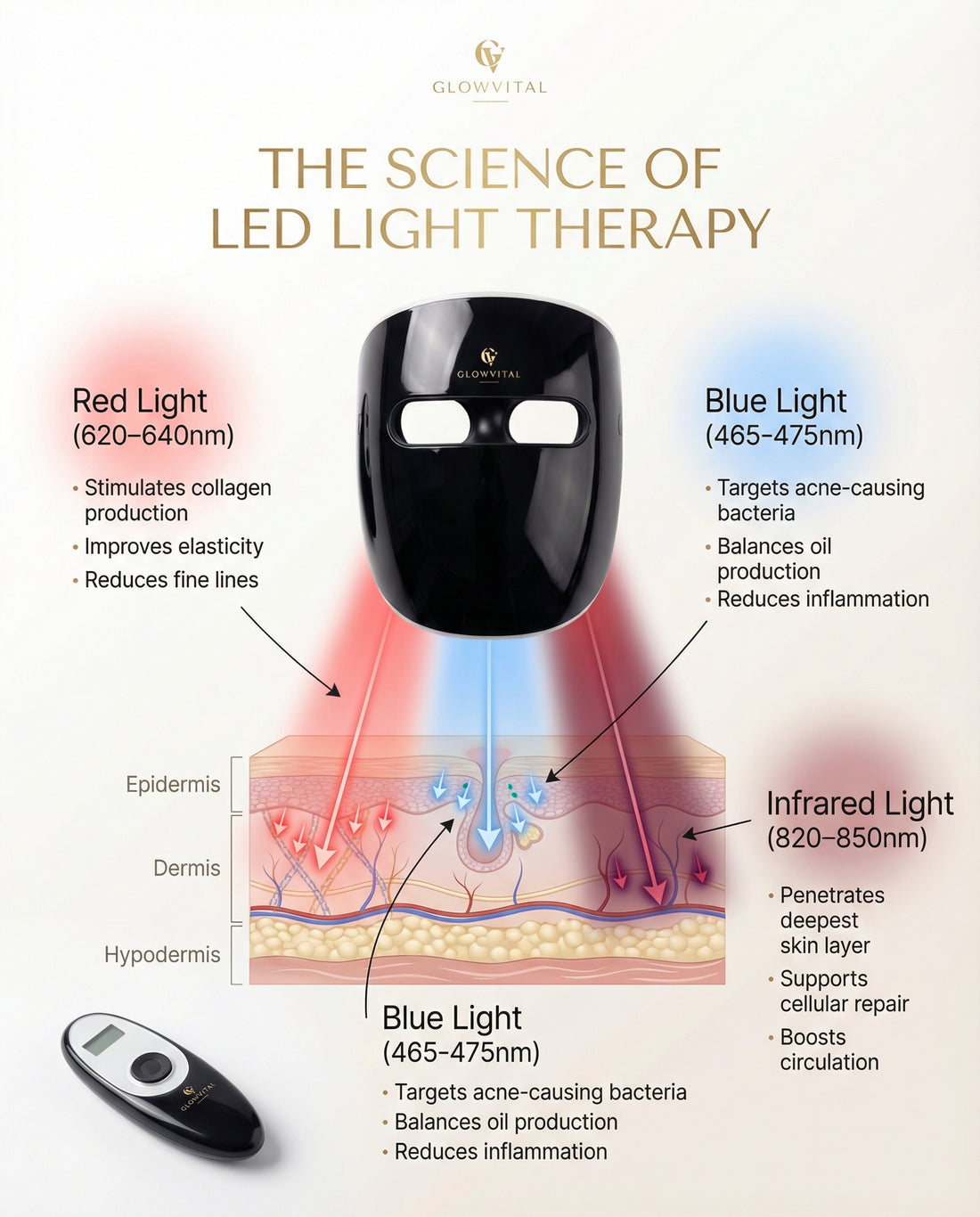
Each wavelength travels to a different depth.
Shorter wavelengths, like blue, are absorbed near the surface. Longer wavelengths, like near-infrared, pass through to the deepest layers. OmniGlow delivers all three at calibrated intensities, so each mode acts where its science works best.
THE THREE WAVELENGTHS
What each colour actually does.
The names Dawn, Clear and Deep map to 30+ years of peer-reviewed photobiomodulation research. Here's what's happening, one wavelength at a time.
465-475nm
Clear, Blue
Depth · 0.5-1mm · epidermis
Blue light works at the skin's surface. It excites porphyrins, molecules produced by Cutibacterium acnes bacteria, triggering an oxidative response that kills the bacteria responsible for inflammatory acne. Clinically shown to reduce lesion counts without the irritation of topical antibiotics or benzoyl peroxide.
620-640nm
Dawn, Red
Depth · 1-3mm · dermis
Red light is absorbed by cytochrome c oxidase in mitochondria, boosting cellular ATP production. The net effect in the dermis: increased collagen and elastin synthesis, faster fibroblast activity, and visibly smoother skin over an 8-12 week window. This is the workhorse wavelength for anti-ageing.
820-850nm
Deep, Near-Infrared
Depth · 5mm+ · deep dermis
Near-infrared is invisible to the eye but penetrates further than any wavelength on the mask. It modulates inflammation, accelerates tissue recovery, and supports the structural matrix that underpins firmness. Used by dermatologists for its calming effect on reactive skin and its role in deep-tissue repair.
THE MECHANISM
Light doesn't sit on your skin. It does something underneath.
The scientific name is photobiomodulation, PBM for short. It's how cells respond to specific wavelengths of light by producing more energy, reducing inflammation, and signalling repair. It's been studied in over 5,000 peer-reviewed papers since the 1960s, and it's what medical-grade LED devices actually do.
01
Light is absorbed
Specific wavelengths are absorbed by chromophores in skin cells, particularly the mitochondria's cytochrome c oxidase enzyme.
02
ATP production rises
This absorption boosts the cell's ATP output, its energy currency, giving skin cells the fuel to perform repair, produce collagen, and regulate inflammation.
03
Skin signals change
Gene expression shifts: fibroblasts make more collagen, inflammation markers drop, circulation improves. You see it as smoother, clearer, firmer skin, typically after 4-8 weeks of consistent use.
CLINICAL EVIDENCE
Backed by measurable results.
OmniGlow's efficacy is based on a 42-participant consumer perception study alongside published PBM research at the same wavelengths and doses.
84%
Of users saw visibly smoother skin after 7 weeks of Red (Dawn) use.
GlowVital consumer perception study · 42 participants · 7 weeks
92%
Saw clearer, calmer skin after 5 weeks of Blue (Clear) use.
GlowVital consumer perception study · 42 participants · 5 weeks
5,000+
Peer-reviewed PBM studies back the wavelengths OmniGlow uses.
Photobiomodulation research · 1960-present
THE OTHER HALF OF THE RITUAL
Recovery science, for the eyes.
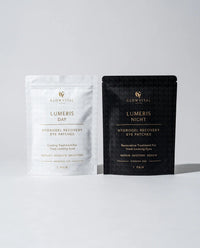
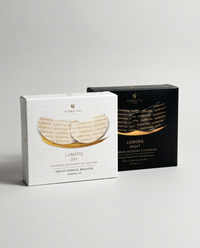
Light therapy works across the face. The skin under the eyes is thinner, drier and shows fatigue first, so it asks for a different tool. Lumeris pairs cooling hydrogel with five targeted actives, in a Day formula and a Night formula.

Lumeris Day · Morning
The fifteen minute reset.
Depuff · Hydrate · Brighten
A cooling hydrogel that goes on in minutes. Menthyl lactate cools on contact while caffeine and hyaluronic acid help tired-looking eyes look fresher and more awake before the day starts.

Lumeris Night · Evening
The quiet last step.
Repair · Restore · Renew
The same hydrogel, worn as you wind down. Formulated with peptides and niacinamide to support smoother, more rested-looking eyes by morning.
Caffeine
Depuffing
Helps reduce the look of puffiness and shadow.
Niacinamide
Brightening
Supports a brighter, more even looking under eye.
Hyaluronic Acid
Hydrating
Holds water to plump the look of fine lines.
Menthyl Lactate
Cooling
A clean cooling sensation the moment it touches skin.
Peptide Complex
Firming
Supports a smoother, firmer looking under eye.
FREQUENTLY ASKED
The science questions we hear most.
Is LED light therapy the same as UV or laser treatment?
No. LED light therapy uses non-coherent, non-thermal visible and near-infrared light at specific wavelengths, there's no UV radiation, no heat damage, no cell ablation. It works by signalling cellular activity, not by destroying tissue. That's why it's safe for at-home daily use.
How does LED actually change my skin?
Skin cells contain chromophores, molecules that absorb specific light wavelengths. When mitochondrial cytochrome c oxidase absorbs red or near-infrared light, ATP production rises, signalling cells to ramp up repair and collagen synthesis. Blue light excites bacterial porphyrins and neutralises acne-causing bacteria at the surface.
Why does it take weeks to see results?
LED doesn't add to your skin, it stimulates your skin to do more of what it already does. Collagen synthesis is a biological process on a weeks-long timeline. Blue light clears existing bacteria quickly (2-5 weeks), but collagen rebuilds over 7-12 weeks. That's just biology, not limitation.
Do the wavelengths really matter?
Enormously. Research has established clear therapeutic windows: roughly 465-475nm for antibacterial blue, 620-660nm for dermal red, and 800-850nm for deep near-infrared. Masks outside these windows may produce light but won't reliably produce clinical outcomes. OmniGlow is calibrated to stay inside these ranges.
Is LED safe for sensitive skin?
Yes, in most cases. LED is non-thermal at treatment intensity and doesn't trigger the histamine or pigmentation responses that light-based clinical devices can. We recommend starting with shorter sessions (5 minutes) and alternating days if you have highly reactive skin. Avoid use if you have photosensitive conditions, see our safety note below.
Can I use it on top of my skincare?
Use OmniGlow on clean, product-free skin. After the session, apply your serums and moisturisers, LED can actually enhance product absorption. Avoid photosensitising actives (some retinoids, AHAs) immediately before use; apply them in your morning or bedtime routine instead.
SAFETY NOTE
Who shouldn't use OmniGlow?
LED light therapy is safe for most skin types and ages, but avoid use if you:
are taking photosensitising medication (consult your GP), have active skin cancer, have lupus or a photosensitive condition, are pregnant (speak to your midwife first), or experience seizures triggered by light. OmniGlow includes eye protection; keep it in place for every session. If you experience any irritation, stop use and consult your dermatologist.
A note from our team
We chose these three wavelengths because the published research supports them, not because they photograph well. Every mode on OmniGlow is set to a dose the studies actually used. Nothing on this page is here for show. It is here because the science supports it.
The GlowVital Team · Designed in the UK
CLINICAL RESULTS
What each mode does.
Blue · Clear
92%
Saw clearer-looking skin in 5 weeks
42-participant consumer perception study
Red · Dawn
84%
Saw smoother-looking skin in 7 weeks
42-participant consumer perception study
NIR · Deep
3×
Deeper skin penetration than red light
Peer-reviewed photobiomodulation research
HEAD-TO-HEAD
How OmniGlow compares
The same clinical science the premium brands use, at a price that isn't a luxury.

| GlowVital OmniGlow | CurrentBody | Omnilux Contour | Typical LED mask | |
|---|---|---|---|---|
| Price | £199.99 | £399 | £315 | ~£120 |
| Light modes | 3 (Red · Blue · NIR) | 2 | 2 | 1-2 |
| Medical-grade LEDs | 120 | 236 | 132 | 60-80 |
| Wireless / cable-free | ✓ Fully wireless | ✗ | ✓ | Varies |
| Session time | 5-10 min | 10 min | 10 min | 10-30 min |
| UK brand & UK support | ✓ | ✓ | ✗ (US) | Varies |
| Klarna Pay in 3 | ✓ | ✓ | ✓ | Varies |
| Money-back guarantee | 30 days | 14 days | 30 days | Varies |
Comparison based on publicly available product specs as of April 2026. Prices in GBP, excluding sale.

The complete ritual · mask and eyes, one system
FREE · 60 SECONDS
Not sure which routine is right for you?
Answer 6 quick questions and we'll build a personalised LED routine based on your skin, your concerns and your schedule.
Get my free routine